
Building Tomorrow's Trades: Rozen Steelworks Joins RAP
We sat down with Daryl Lynes, RSW's Lead mentor and the driving force behind our new apprenticeship initiative, to talk about why bringing young people into the trades early is the single most important thing we can do for the future of our industry.
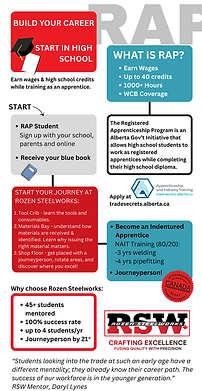
At Rozen Steelworks, we build things that last. Structural steel, pipe systems, precision fabrication. The kind of work that keeps energy flowing and industry moving. But great work doesn't happen without great people, and right now the skilled trades are facing a serious shortage. That's why we're proud to announce that Rozen Steelworks has joined the Alberta Government's Registered Apprenticeship Program (RAP)!
WHAT IS THE REGISTERED APPRENTICESHIP PROGRAM (RAP)?
The Registered Apprenticeship Program (RAP) is an initiative run by the Government of Alberta that allows high school students, typically in Grade 11 or 12, to work as registered apprentices while still completing their high school diploma. It's a uniquely flexible program designed to bridge the gap between classroom and jobsite.
Here's how it works: students split their time between high school course requirements and real, paid work at an approved employer. They earn at least minimum wage for their hours, accumulate up to 1000 hours toward their first year of apprenticeship training, and can earn up to 40 high school credits. WCB coverage is provided by Alberta Education while the student is enrolled, so they're protected from day one. For students in the Parkland County or Edmonton area, Rozen Steelworks is an ideal placement. We've already welcomed our first RAP student and are actively building relationships with schools in Stony Plain, Spruce Grove and Sturgeon County.
IN CONVERSATION WITH DARYL LYNES - RSW'S LEAD MENTOR
Daryl Lynes has spent his career in the trades and has mentored RAP students across multiple businesses with a track record that speaks for itself: 45 students mentored, and every single one has gone on to earn their Journeyman certificate and stayed in the trade. Some work as employees while others have started their own businesses.. We asked Daryl about his philosophy, his approach, and why he wanted to bring this program to Rozen.
Q: What made you want to sign Rozen up for the RAP program?
Daryl: I had great success with my business before, taking on RAP students. We would take on at least 6 per year. The students looking into the trade at such an early age have a different mentality than others because they already know what their career path is going to be at 17 years old. This makes them an ideal candidate to mentor and mold into a key part of the organization. Most companies are not willing to take the time to mentor their employees at a young age and they only want to hire experienced people. I feel this is kind of a backwards approach to the trade shortage we have in today's world. The RAP program is available for us to utilize, so i feel its a great opportunity to mold young tradespeople into valuable employees.

Q: What kind of work do RAP students do at Rozen?
Daryl: I like to start the RAP students off gradually. The first step is in the tool crib. They get an understanding of what consumables are being used, what the tools look like and what they are for, and they get to know all the employees on the floor. This gives them confidence in knowing what tools and consumables they may need for a task, and it takes away any shyness about being around other employees. It can be a little overwhelming coming into a shop this size as a new hire.
Daryl: The second step is to work in the material bay so they can get an understanding of how things are received, what the material actually looks like, and the importance of making sure the right material is issued to the job. This builds confidence in knowing what to ask for and helps them identify if something is not right when they get on the floor to work on their own projects.
Daryl: After that, we start them in one of the areas in the shop. The student will be placed with a Journeyperson who will be their mentor, and they'll work with different Journeypersons throughout their time here. I feel this gives them the opportunity to see what's all involved in the facility, and they can have a better idea of what the trade is about and whether its a right fit for them. They can also see what areas interest them the most.
Q: What would a RAP student's future progression look like if they stayed at Rozen after high school?
Daryl: One of the biggest bonuses for the RAP students is they complete the program, graduate, and then become an indentured apprentice right out of high school. They receive their blue book, so technically they can sign up for NAIT right away. If they stay on track, they will become a Journeyperson by age 21. Depending on the trade the student chooses, the apprenticeship will be a different length. Welding is 3 years, pipefitting is 4. Either way, starting through RAP means they're years ahead of where they'd be otherwise.

Q: Is this program focused on structural work, piping, or both?
Daryl: Right now we are primarily focused on CNC, Structural, and Yard work for the RAP students. Rozen is quite different from most shops out there as we do quite a variety of work, and its hard to find versatile people that can think outside the box. There are many years' worth of experience within Rozen's employees, so we have to start teaching and spreading the knowledge. The goal is for RAP students to eventually rotate through all the areas of the shop, including pipe, as we grow the program.
WHY THIS MATTERS - THE TRADES SHORTAGE IS REAL
Canada is facing a critical skilled trades shortage. According to BuildForce Canada, the construction industry alone will need to recruit over 350,000 new workers over the next decade to replace retiring workers and meet new demand. Welders, pipefitters, CNC operators, and fabricators are in short supply, and that gap is only growing.
The traditional pathway into the trades - finish high school, enroll in trade school, find an employer - is too slow. By the time a person completes that process, they may be 22 or 23 before they're even a first-year apprentice. The RAP program collapses that timeline significantly.
But beyond the numbers, there's something deeper at work. Daryl's philosophy - one backed by 45 successful mentorships - is that young people who choose a trade at 16 or 17 are different. They're motivated, curious, and they take ownership; they chose it. That mindset produces better tradespeople.
To apply head to: tradesecrets.aberta.ca


